
Meeting/Event Information
Workplace AI: Emerging Ethics and Regulatory Pressure Points
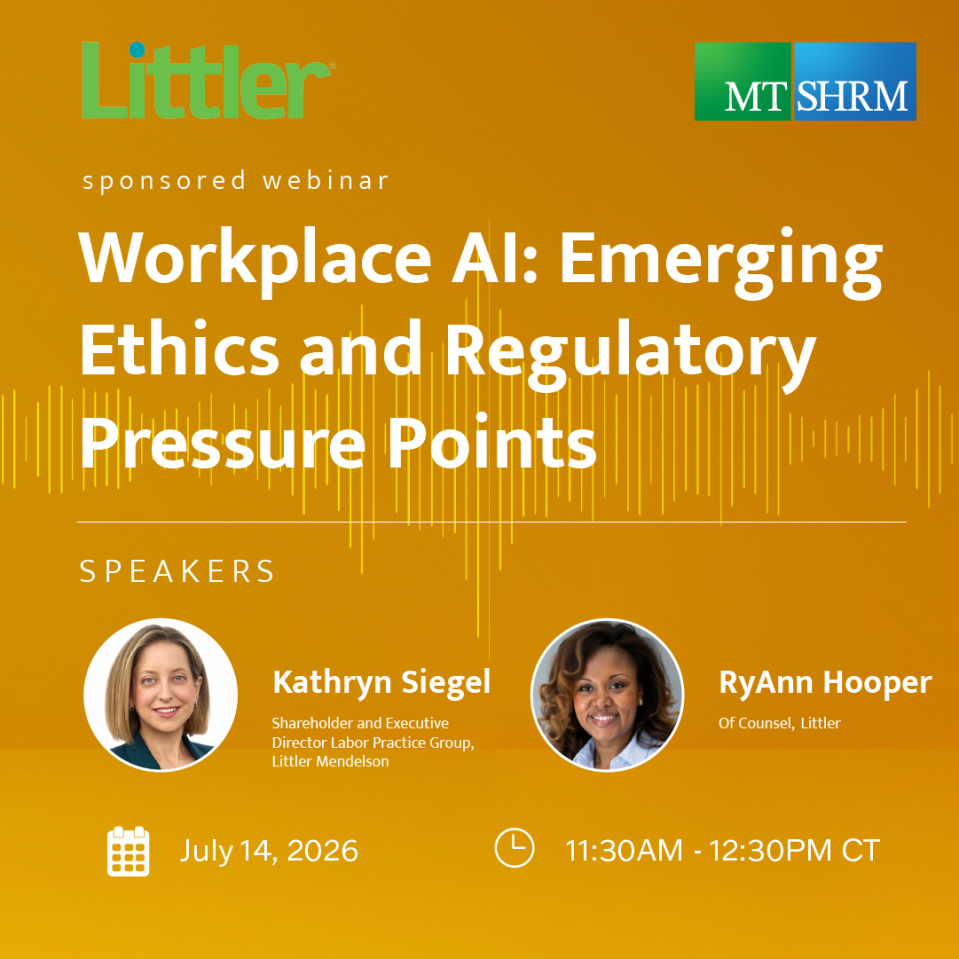
July 14, 2026 | 11:30 AM CDT - 12:30 PM CDT
Add to Calendar
Online only |
Directions
Presented by: Kathryn Siegel, Shareholder and Executive Director Labor Practice Group at Littler Mendelson and RyAnn Hooper, Of Counsel at Littler Mendelson
As artificial intelligence plays a growing role in workplace decision-making, organizations are facing a rapidly shifting mix of legal, regulatory, and ethical expectations. Evolving legislation, stricter data privacy standards, and heightened oversight of automated systems are redefining what compliance looks like for employers. At the same time, concerns about bias, fairness, and transparency are fueling increased enforcement activity and legal risk.
This webinar explores where these challenges are taking shape and what they mean for today’s workforce. HR leaders will gain a clearer view of emerging risks and why staying ahead of these developments is critical right now.
Learning Objectives:
- Identify emerging AI regulations and privacy requirements that are reshaping employer obligations in the workplace.
- Recognize ethical risks — including bias, transparency gaps, and data misuse — associated with automated decision-making tools in HR contexts.
- Assess organizational exposure to enforcement actions and litigation trends driven by evolving AI compliance standards.
Login details: After you register, login instructions will be included in your event receipt email.
Certification: 1 SHRM and HRCI recertification credits have been submitted for review.
Tickets:
-
Members: No cost - included in your membership

Thank You To Our Presenters:
Kathryn Siegel, Shareholder and executive director labor practice group, littler mendelson
RyAnn Hooper, of counsel, littler mendelson


Kathryn Siegel is a shareholder and executive director of Littler’s Labor Practice Group, where she helps lead the firm’s national labor strategy while continuing to advise employers in matters of employment law and labor relations.
As executive director, Kathryn oversees the strategic planning, practice operations, talent development, and delivery of labor-focused legal services across Littler’s national platform. She works closely with practice leadership to evolve how labor services are delivered, align labor strategy with client business objectives, and ensure the firm remains at the forefront of complex and emerging labor issues.
Kathryn advises employers on the full spectrum of labor law matters and labor relations strategy, including collective bargaining, labor-management relations, union organizing campaigns, unfair labor practice proceedings, and labor arbitration.
She regularly partners with senior executives, in-house legal leaders, and human resources leadership to address complex labor challenges and counsels on high-stakes labor issues. Her strategic guidance helps employers navigate labor risk and workforce strategy in a rapidly evolving labor environment.
Kathryn also serves as a strategic advisor for employers on employment law matters at the intersection of labor relations, including issues arising under Title VII, the ADA, the ADEA, the FMLA, and comparable state and local laws, particularly where those issues impact collective bargaining relationships or workforce strategy.
She is actively involved in shaping labor law policy and best practices at the national level, including as a long-standing member and recent management co-chair of the American Bar Association’s Committee on Practice and Procedure Under the National Labor Relations Act. Kathryn also regularly speaks and writes on significant labor law developments impacting employers nationwide.
In law school, Kathryn was founder of the Vanderbilt Labor and Employment Law Society.
RyAnn M. Hooper has two decades of experience advising clients on labor relations, employment and workforce strategy across public and private sectors, including 10 years at the National Labor Relations Board (NLRB).
Prior to joining Littler, RyAnn led a Fortune 100 company’s global employment law function, overseeing employment litigation strategy and advising on a range of workplace risks, employment matters and corporate governance issues. Well-versed in new workplace technologies, she helped to design and implement artificial intelligence (AI) tools while ensuring legal defensibility, fairness and alignment with evolving regulatory frameworks. Her work included advising on complex employment counseling matters, executive-level decision-making and the legal implications of emerging technology impacting the work.
During her time at the NLRB, RyAnn served as board counsel and later as a senior trial attorney, where she prosecuted complex labor disputes and acted as lead counsel on several precedent-setting cases.
She also worked in private practice advising employers on a range of labor relations matters, including collective bargaining negotiations, union organizing campaigns, NLRB elections and labor litigation.



 Sponsor Presented / Special Event
  Approved Speaker Direct